

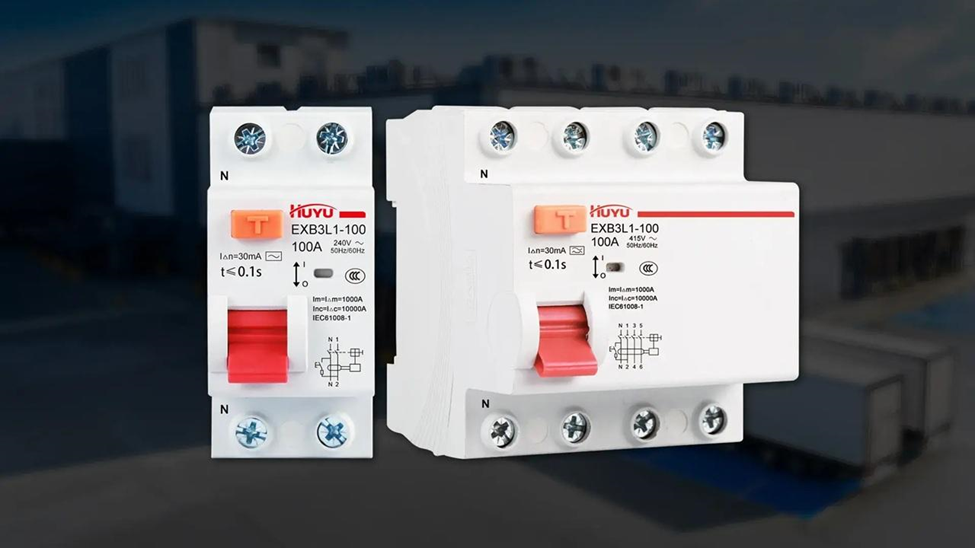

The use of overcurrent protection is not the only source of electrical safety in relatively modern buildings. Although miniature circuit breakers and fuses are used to provide overload and short circuit protection of wiring and equipment, they do not directly guard people against receiving an electric shock due to earth leakage. This is where Residual Current Circuit Breakers or RCCBs are very crucial. Huyu Electric produces the RCCBs, which are used to measure the harmful leakage currents promptly and disconnect the power till the damage is done. This is important to the people engaged in electrical design, installation or maintenance to understand how these devices operate and how they minimize fire risk.
What an RCCB Is Designed to Do
A Huyu Electric RCCB is a protection device that is used to check the current between the live and neutral conductors. In a nominal situation, the current exiting the phase conductor is the same as the current coming back on the neutral. The currents form magnetic fields that cancel. In the case of an insulation fault or an inadvertent touching of a live part, some current will be conducted to earth, rather than being conducted via the neutral. This creates an imbalance. This difference is called residual current and is identified by the RCCB, and the circuit is tripped when this difference is greater than a preset sensitivity. The RCCBs are leakage to earth oriented, unlike the MCBs, which are overload oriented. They are mainly aimed at human safety and fire prevention.
Electrical Shock Safety
Electric shock is caused when the current is passed through the human body. Even quite low currents may result in muscle contraction, difficulty in breathing or irregular heart rhythm. Personal protection is usually performed by Huyu Electric RCCBs with a sensitivity of 30 mA since this value is low enough to minimize the threat of fatal shock. In case an individual accidentally touches a live conductor and offers a path to earth, leakage current passes through the body. The RCCB identifies the imbalance and cuts the circuit in a short period of time. The rapid break connection restricts the size and the weight of the current flowing through the individual. Such protection is particularly significant in those environments where individuals can have contact with electricity-related devices, e.g., homes, offices, workshops, and construction sites.
Prevention of Electrical Fires Role
Electrical fire commonly begins due to insulation or ruined cables, permitting current to escape to the earth or to the structures of the building. Such leakage current can be insignificant enough not to give an overcurrent device a trip, but it can lead to heat generation with time, which burns nearby materials. Huyu Electric RCCBs assist in avoiding such fires through the detection of the small leakage currents that imply the insulation failure. The device cuts off the circuit before the fault point can continuously heat, therefore, eliminating the heat effect. RCCBs offer an added protection on top of the traditional breakers in older buildings where the wiring insulation can be of an inferior quality. They serve as an early warning and disconnection system to faults that develop.
Sensitivity Ratings and Their Meaning
RCCBs are available with different residual current sensitivities. Huyu Electric offers models designed for various protection levels. Devices rated at 30 mA are typically used for direct contact protection of people. Higher sensitivity levels, such as 100 mA or 300 mA, are often used for fire protection at the distribution board level. The choice of sensitivity depends on the application. Other circuits used to supply socket outlets or portable equipment often need a greater sensitivity to safeguard the users. Large installations can use higher thresholds in the main incomer RCCB to prevent nuisance tripping without preventing the main incomer RCCB from noticing significant leakage that can cause fire. Proper choice guarantees safety as well as safe usage.
Types of RCCBs for Modern Loads
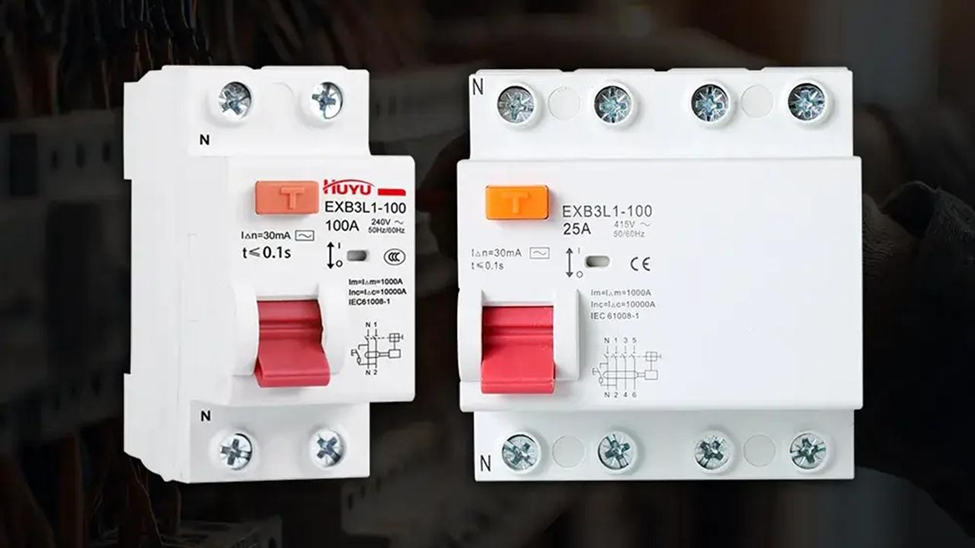
Electrical installations today include many electronic devices that produce different types of leakage current. Huyu Electric manufactures RCCBs in various types to respond to these conditions. The Type AC RCCBs are used to detect the simple alternating leakage current, which is sinusoidal in nature and can be applied in simple resistive loads. Type A RCCBs have the capability of sensing alternating current as well as pulsating direct leakage currents, which are typical in electronic powered equipment. More sophisticated versions like Type F or Type B are programmed to accept complex leakage waveforms due to variable speed drives, inverters and other equipment of the modern era. The appropriate choice of the RCCB type will make the equipment run correctly and will not be blinded by the non-standard currents.
Integration with Other Protective Devices
An RCCB does not protect against overloads or short circuits. For complete protection, Huyu Electric RCCBs are used together with MCBs or MCCBs. The overcurrent device protects wiring from excessive current, while the RCCB monitors earth leakage. In some installations, RCBOs combine both functions in one unit. However, separate RCCBs and MCBs are still widely used, especially at the distribution board level, where multiple circuits share one RCCB. Proper coordination between devices ensures that both shock protection and equipment protection are provided.
Installation Considerations for Effective Protection
For an RCCB to function correctly, both phase and neutral conductors of the protected circuit must pass through the device. The neutral must not be connected to other neutrals downstream of the RCCB, as this can create false imbalance and unwanted tripping. Earthing and bonding must also be correctly implemented. The RCCB relies on a low impedance path to earth so that leakage current can flow and be detected. Poor earthing reduces effectiveness. Huyu Electric has an installation guideline that provides the guidelines that wiring should follow so that leakage can be properly detected and tripping can be done reliably.
Conclusion
Residual Current Circuit Breakers have a distinct mission, and they are designed to sense leakage current and cut off power before it is damaged or ignites a fire. Huyu Electric RCCBs offer this protection with sensitive detection and rapid tripping technology in a very broad application. When properly chosen, installed, and serviced, such devices serve as an extensive security in the background of the electrical systems. They are the solution to risks that cannot be managed by the traditional breakers, which is why they are considered to be one of the key features in contemporary electrical safety design.
