

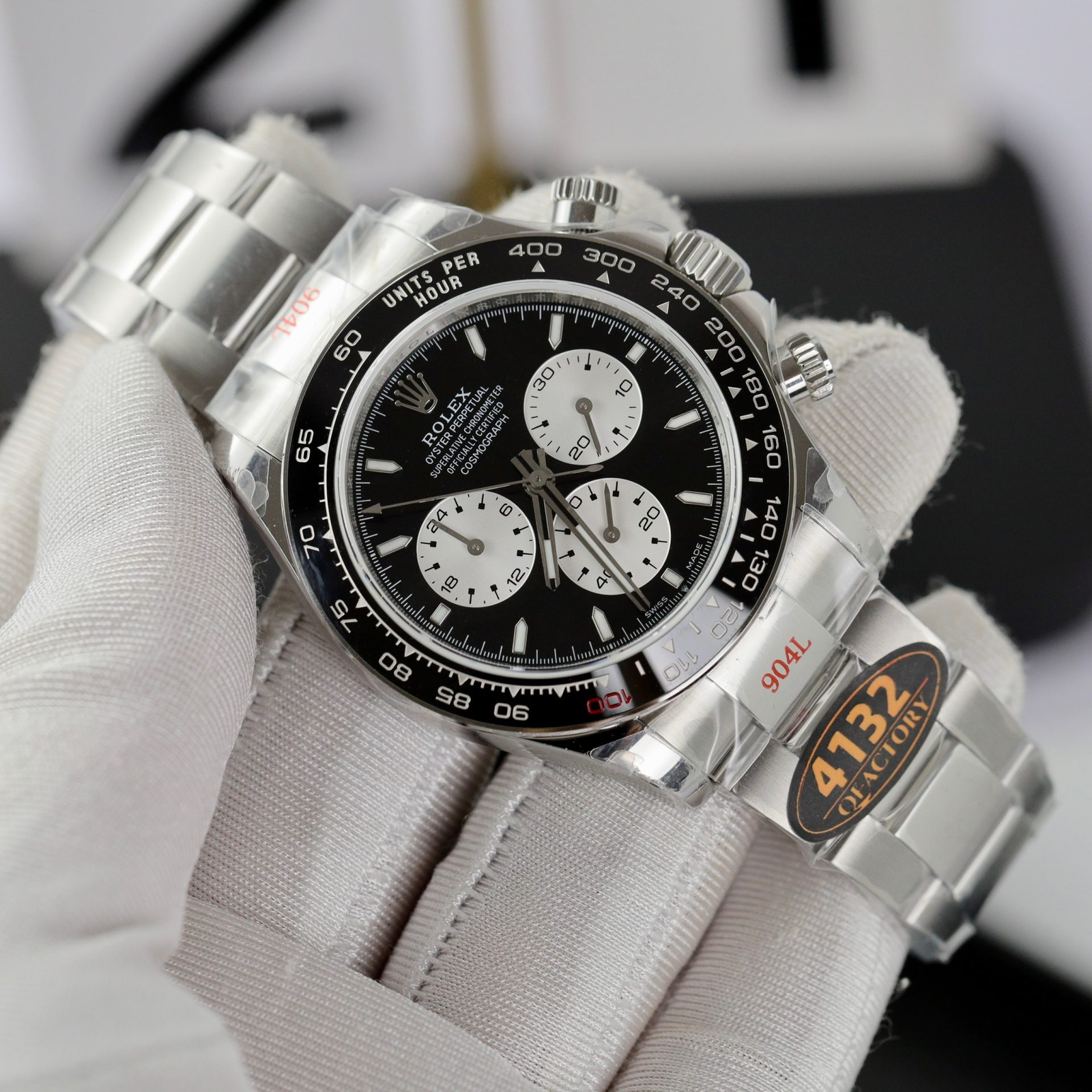

The Daytona is different from every other Rolex reference. Not because it’s more expensive or harder to get at retail — though both are true. Because it’s a chronograph. And chronographs are mechanically more complex than a three-hand watch by a significant margin.
That complexity doesn’t just affect the genuine watch. It affects how well a replica can pull it off. A Submariner clone has to get the bezel insert right, the date wheel magnification, the rehaut engraving. A Daytona clone has to do all of that and make three subsidiary dials work correctly, plus a column-wheel chronograph mechanism that starts, stops, and resets with crisp precision.
Most don’t. Even at the super clone tier, the Daytona exposes weaknesses that other references can hide.
Why the Daytona Is the Hardest Rolex to Clone Well
The Cosmograph Daytona uses the caliber 4130 (or 4131 in newer references), an in-house automatic chronograph movement with a column-wheel and vertical clutch. That’s not decoration — it’s functional architecture that affects how the pushers feel and how the chronograph hands behave.
A three-hand watch has one hand stack: hours, minutes, seconds. A chronograph has four if you count the running seconds at 6 o’clock, plus the 30-minute counter at 3 and the 12-hour counter at 9. That’s three additional gear trains, each with its own pinion, its own friction spring, its own reset hammer.
Getting all of that to work reliably and look correct and fit inside a 40mm case is a serious engineering challenge for a legitimate manufacture. For a replica rolex factory working with reverse-engineered drawings and limited access to genuine movements, it’s a nightmare.
The result is that Daytona clones often look right in photos but fall apart in person. The chronograph hands don’t reset to zero. The sub-dials are spaced wrong. The pushers feel mushy or don’t screw down at all.
The Chronograph Sub-Dial Alignment Issue
This is the single biggest visual tell on a Daytona clone, and it’s surprisingly common even on high-end pieces.
The genuine Daytona has three sub-dials arranged in a precise triangle: running seconds at 6 o’clock, 30-minute counter at 3 o’clock, 12-hour counter at 9 o’clock. The spacing between these registers is fixed. The diameter of each sub-dial is identical. The hash marks are evenly spaced and hair-fine.
On a clone, the sub-dials are often slightly too large or too small. Or they’re positioned a fraction of a millimeter off from where they should be. Or the spacing between the three letters “TER” in “CHRONOMETER” below the crown is wider than on the genuine article.
These are micro-differences. You won’t see them from three feet away. But if you’re comparing a clone side-by-side with a genuine reference image, they’re obvious. And they’re hard for a factory to fix because fixing them requires retooling the entire dial printing process.
Panda vs. Le Mans Dial Variants
The Daytona comes in two dial configurations that matter for clone-spotting: the white “Panda” dial with black sub-dials, and the black “reverse Panda” dial with silver sub-dials.
On the Panda dial, the sub-dials are black against a white background. The contrast makes any misalignment more visible. On the reverse Panda, the silver sub-dials against black are slightly more forgiving — but the silver printing has to be crisp and opaque, not thin or translucent.
The Le Mans dial (introduced for the 2023 24 Hours of Le Mans centenary) adds a red “DAYTONA” text and a different sub-dial layout. It’s been heavily replicated, but the red text is notoriously hard to get right. Too bright, too dark, or the wrong shade entirely.
The best clones get these details close. None get them perfect. The dial printing on a genuine Rolex is done with a specific type of pad-printing that produces razor-sharp edges and consistent ink depth. Clone dials often show slight bleeding or unevenness under magnification.
Movement Reality: 4130-Generation Clones
The movement is where the Daytona really separates the good from the bad.
Top-tier Daytona clones use a cloned 4130 movement. Both Clean Factory (pre-shutdown) and VSF have produced versions. The clone movements run at 28,800 beats per hour (4Hz), which gives the seconds hand a sweeping motion that matches the genuine article.
But there are differences. The genuine 4130 has a column-wheel chronograph with a vertical clutch. The clone movements replicate this architecture, but the finishing isn’t the same. Under a display case-back (which some clones offer), the movement finishing is a clear tell — the genuine has perlage, Geneva stripes, and beveled edges that the clone can’t match at the same level.
More importantly, the clone movements don’t have the same longevity. A genuine 4130 will run for decades with proper service. A clone movement — even a good one — has a practical lifespan of 4-7 years before it needs service or replacement. The parts aren’t interchangeable with genuine Rolex service components, so when it breaks, you’re looking at a movement swap, not a repair.
What Actually Gives a Daytona Clone Away
Here’s the honest list of tells that still work on even the best Daytona super clones:
The pushers. Genuine Daytona pushers screw down. Most clones have push-pull pushers that don’t screw. Or they screw but the thread feel is wrong. Or they’re decorative and don’t actually engage the chronograph mechanism.
The reset. Press the reset pusher at 4 o’clock. On a genuine, all three chronograph hands snap back to zero simultaneously. On a clone, they often stagger — the seconds hand returns to zero a beat after the minute counter, or the hour hand lands slightly off.
The rehaut engraving. The inner bezel ring on a modern Rolex is laser-engraved with “ROLEX” repeated around the circumference, with the serial number at 6 o’clock. Clones often have misaligned engraving, smudged coronets, or incorrect font depth.
The laser-etched crown at 6 o’clock. Genuine Rolex crystals from the early 2000s onward have a tiny laser-etched coronet at 6 o’clock. It’s visible only under certain lighting angles. Clones either omit it, make it too visible, or get the microtext wrong.
The lume. Under UV light, genuine Rolex lume is even in color and temperature. Clone lume is often patchy, the wrong color (too green or too blue), or unevenly applied.
The bracelet. The Solid End Links (SELs) on a genuine Daytona fit flush against the case with minimal gap. Clone bracelets often have visible gaps or uneven finishing on the clasp interior.
Water resistance. Genuine Rolex pressure-testing and gasket engineering isn’t matched by any clone. A clone might survive a splash, but it won’t pass a 100m pressure test.
Where to Actually Start Looking
If you’re in the market for a Daytona clone, the first thing to understand is that the factory landscape has shifted. Clean Factory (CF) was the benchmark for Rolex sports models for years, but the factory was raided in July 2025 and is not returning. VSF is now the default top-tier producer for most references, including the Daytona.
VSF’s Daytona uses a 316L case — technically different from the 904L steel used by genuine Rolex — but the case finishing is competitive with what Clean produced. The VSF 4130 clone movement runs reliably and the dial printing is consistent. Some collectors prefer VSF’s case finishing over Clean’s on the Daytona specifically.
That said, the super clone tier is not a monolith. Different factories excel at different references. A factory that makes a great Submariner might produce a mediocre Daytona. The chronograph complexity means the Daytona is a separate buying decision from the three-hand models.
A dedicated ROLEX super clone retailer will usually tell you which factory produced a given watch. That’s important because factory reputation is the single best predictor of quality in this market. A dealer who can’t or won’t disclose the factory source is a dealer to avoid.
The other thing to look for is QC photos — high-resolution images of the actual watch you’re buying, not stock photos. Good dealers provide these. Bad dealers don’t. The QC photos let you check the sub-dial alignment, the rehaut engraving, and the date wheel (if applicable) before you commit.
The Daytona is the hardest Rolex to clone well. That means the gap between a good clone and a bad one is wider than on a Submariner or a Datejust. The good ones are genuinely impressive — they get the proportions right, the movement works, the bracelet feels solid. But they’re not perfect. The tells are there if you know where to look. And the movement won’t last forever. Go in with your eyes open, and you won’t be disappointed.
