

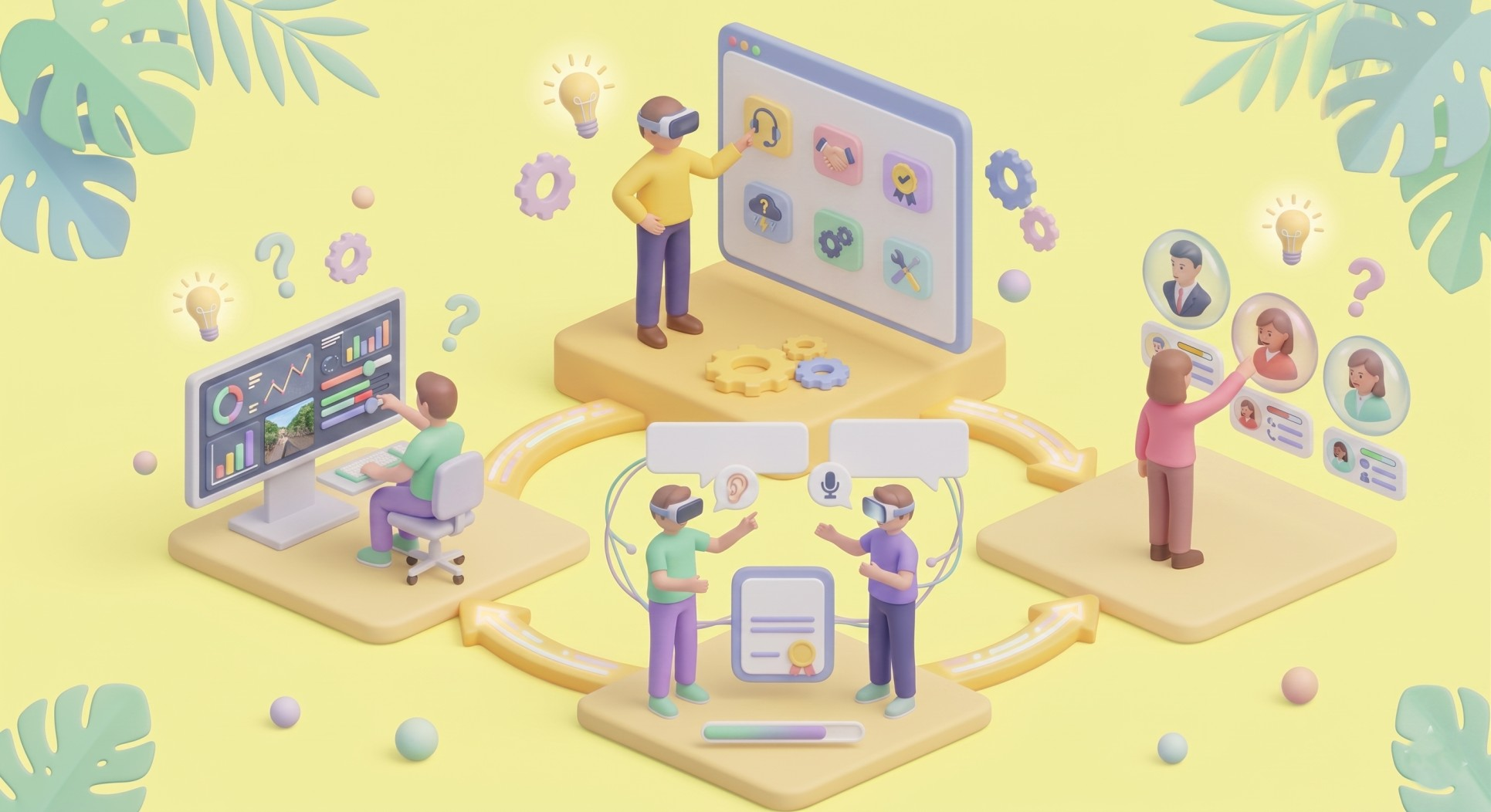

Preparing employees for difficult workplace interactions requires more than reading a handbook. Traditional training methods struggle to replicate the unpredictability of a frustrated customer or an anxious patient. This is precisely where AI persona simulation is transforming the approach to professional education. By interacting with a carefully designed digital character, a learner can experience the emotional weight and conversational flow of a real-world encounter without any of the real-world risks.
For Registered Training Organisations and corporate learning teams across Australia, this technology provides a safe environment to build critical soft skills. Rather than acting out awkward scenes with a colleague in a classroom, trainees can now interact with highly realistic characters that respond dynamically to tone, empathy, and professional judgement. This approach bridges the gap between theoretical knowledge and practical capability.
Why AI Persona Simulation Moves Beyond Generic Chatbots
When people hear about artificial intelligence in communication, they often picture a standard customer service chatbot. Those systems are designed to answer basic questions, route support tickets, or follow a rigid decision tree. They are entirely predictable and focus purely on information retrieval.
In stark contrast, AI persona simulation focuses on human behaviour. A training persona is not there to be helpful or to provide the correct answer immediately. Instead, it is built to behave like a complex human being with specific motivations, frustrations, and communication quirks. If a trainee asks a closed question, the persona might give a blunt, one-word answer. If the trainee sounds dismissive, the persona might become defensive or angry.
This distinction is crucial for vocational education. Generic chatbots cannot teach a retail worker how to de-escalate a conflict. They cannot teach a nurse how to comfort a grieving family member. True conversational capability requires an unpredictable partner. When an employee only practises with predictable multiple-choice options, they build a false sense of security that quickly shatters during a real confrontation. By moving away from static scripts and predictable videos, educators can finally provide interactive AI learning scenarios that actually test a learner’s ability to think critically under pressure.
The Anatomy of a Believable Training Persona
What makes an AI character believable enough to be useful for serious skill-building? The secret lies in deliberate persona design. A simulation is only effective if the learner forgets they are speaking to a machine and begins to treat the interaction as a genuine professional encounter.
Creating effective AI training personas involves programming several distinct variables. The first is tone and personality. A persona could be instructed to be highly articulate but impatient, or perhaps confused and repetitive. This foundational personality dictates how the character will respond to different communication styles. Unlike a human colleague who might laugh or break character when a scenario feels uncomfortable, an artificial persona maintains its programmed psychological state indefinitely.
The second variable is the scenario context. A persona needs a backstory. If the simulation involves an aged care resident, the persona must understand their own fictional medical history, their daily routine, and the specific reason they are currently upset. This contextual depth prevents the conversation from feeling hollow.
The most critical variable is escalation behaviour. A well-designed persona has clear triggers for calming down or becoming more agitated. If a trainee in a leadership programme uses active listening and validates a colleague’s concerns, the persona should logically de-escalate. If the trainee uses aggressive or restrictive language, the persona must push back. This dynamic reaction is what makes persona-based training so effective for teaching nuanced communication strategies. 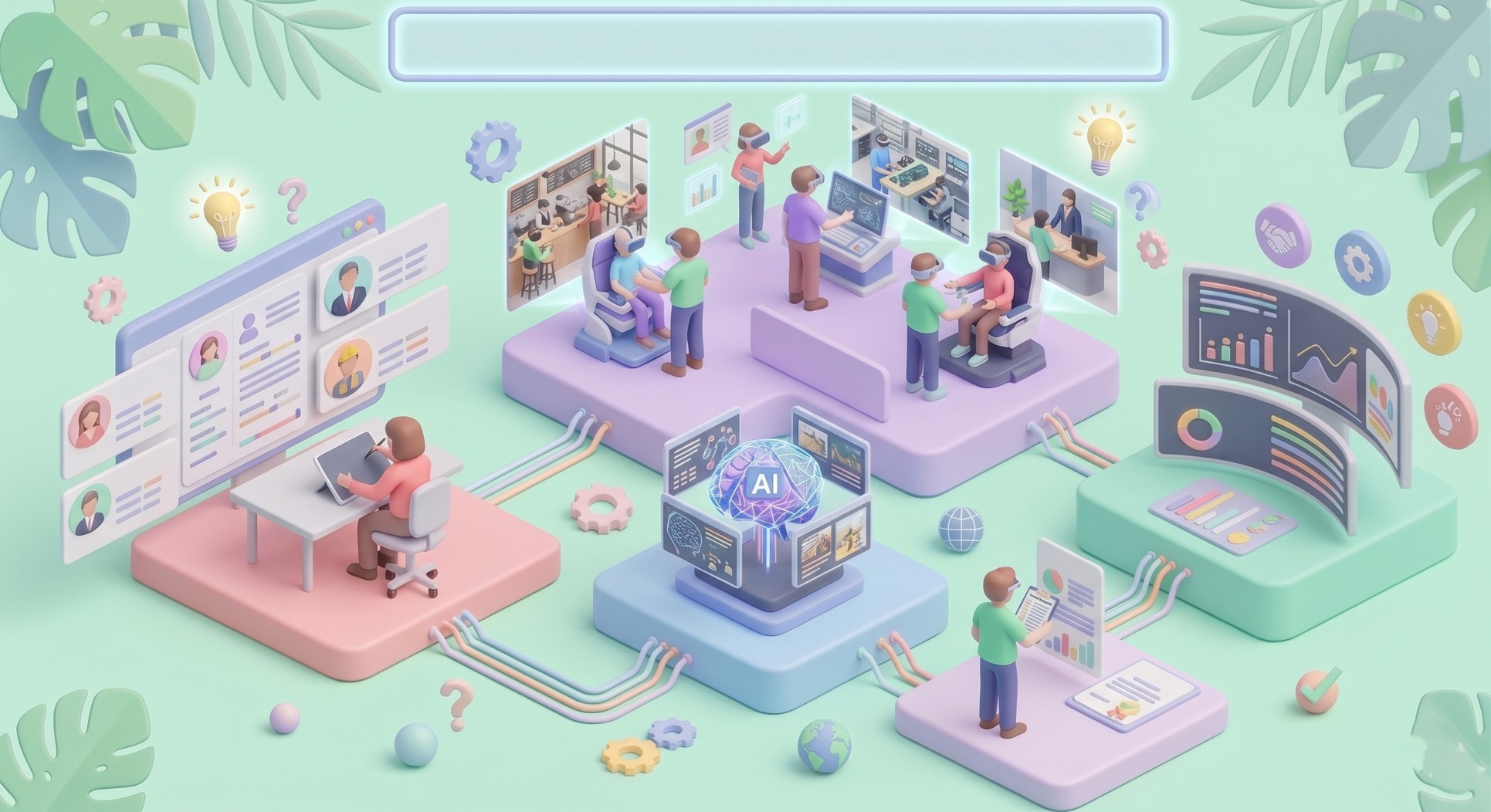
Real-World Applications Across Industries
The versatility of AI character simulation allows it to be applied across a vast range of industries and training packages. Any role that requires high-stakes communication can benefit from this approach.
In the healthcare and community services sectors, trainers use these simulations to replicate highly sensitive interactions. A nursing student might face a persona simulating a patient who is refusing to take their medication due to anxiety. The student must use empathy to uncover the root cause of the anxiety rather than simply repeating clinical instructions.
In the hospitality and retail sectors, the focus often shifts to conflict resolution. A trainee might encounter a persona playing the role of a furious customer demanding a refund for a perceived service failure. The learner must practise specific de-escalation protocols, apologising without necessarily accepting liability, and finding a practical solution to calm the situation. Local government workers can similarly practise handling disputes with distressed community members over planning permissions or council services, ensuring they remain professional under verbal pressure.
Corporate learning teams also rely heavily on this technology for management training. A newly promoted leader can undertake practising conversations with AI to prepare for a difficult performance review. The persona might act defensively, offer excuses, or challenge the manager’s authority. Experiencing these reactions in a simulation ensures the manager is not caught off guard when a similar situation inevitably occurs in the real workplace.
The Advantages of Scaling Simulations
For organisations managing large teams or distributed workforces, relying on live, one-off roleplay sessions is logistically exhausting. Coordinating trainers, scheduling classroom time, and pairing up reluctant colleagues takes an immense amount of administrative effort. Furthermore, the quality of a live roleplay depends entirely on the acting ability of the human partner.
Transitioning to simulated environments completely removes these logistical barriers. A digital persona is available at any time, allowing learners to practise their skills whenever it suits their schedule. This level of accessibility is particularly valuable for shift workers in healthcare or retail who cannot easily attend traditional daytime workshops.
More importantly, digital simulations provide an objective baseline for assessment. In a classroom, a trainer can only observe one pair at a time, leading to inconsistent feedback. Extensive studies on simulation-based learning highlight that consistent, objective feedback is a primary driver of successful educational outcomes. When a learner completes a simulated conversation, the system instantly generates a transcript and a personalised analysis of their performance. Assessors can see exactly how many times a student interrupted the persona, whether they used positive phrasing, and if they successfully reached the learning objective. This data-driven approach removes the guesswork from competency assessments, providing trainers with concrete evidence to support their compliance reporting.
Building a Resilient Workforce
Effective communication is the foundation of almost every successful business operation. Whether a professional is managing a frustrated client, negotiating with a supplier, or coaching a junior team member, their ability to manage complex dialogue is crucial. Theoretical knowledge is simply not enough. By integrating dynamic, realistic digital characters into their training programmes, organisations can provide the practical experience necessary to build genuine conversational competence. They can create a secure space for trial and error, ensuring their teams step into the workplace with the confidence and capability to handle whatever situations arise.
