

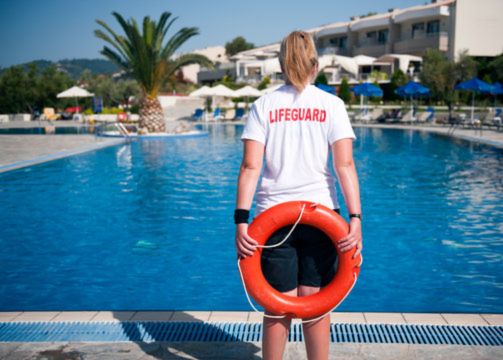

You’ve seen the classic summer scene everywhere: a lifeguard sitting in the tall chair, watching over a sparkling blue pool on a sunny day. It looks like the perfect job—you get to be outdoors, stay active, and help people. But how easy is it to actually get hired for one of these positions?
The truth is, it’s not a simple yes or no. For a motivated person who is willing to put in the effort, getting a lifeguard job is a very achievable goal. What can you do with a lifeguard certification? It opens the door to employment at a wide variety of aquatic venues. Throughout the United States, there is always a great demand for qualified lifeguards.
These venues—from municipal pools and large waterparks to quiet beaches and private community centers—depend on a group of alert lifeguards. Any job seeker who has completed the required initial preparations is greatly favored by this high demand.
What is the First Step to Becoming a Lifeguard?
Getting a valid lifeguard certification is the one most essential step—one completely non-negotiable. Your permission to be taken into account for the position is this certificate. It is a paper proving to an employer that you have passed a demanding course encompassing First Aid, CPR, AED (automated external defibrillator) usage, and water rescue techniques.
Your application will most likely never even reach the interview stage without this credential. It is the basic building block upon which your whole campaign is developed. This accreditation distinguishes a professional rescuer from a casual swimmer.
One single, monolithic certification is not a lifeguard certificate. Employers usually accept a few of the major ones; various groups provide these certifications. This is the point at which companies like the American Lifeguard Association show up. Among the most often acknowledged national organizations offering this necessary training and credentialing are they. Signing up for a course means you promise to combine rigorous in-water practice with classroom education.
Where Can I Find the Necessary Lifeguard classes?
One of the reasons entering this career is so simple is how easy it is to locate lifeguard classes. The same groups that provide certifications run the training sessions. Usually many results will come from a fast internet search for lifeguard courses close to me, particularly as the summer season approaches. Local community centers, the YMCA, universities and colleges, as well as private training businesses all offer these classes. Many aquatic facilities that hire lifeguards will even hold their own certification programs, occasionally with the motivation that graduates who pass will be rapidly hired for an interview.
The architecture of these courses aims to be all-encompassing. They are several-day commitments often stretched over a weekend or many weeknights rather than short workshops. This approach guarantees that pupils have enough time to absorb the difficult material and practice the physically demanding talents till they become second nature. Although the price of these courses can range, it is an investment in your professional credentials.
What Are the Prerequisites for Certification?
You have to satisfy certain basic conditions before you may even enroll in a certification course. Designed to guarantee you possess the basic strength and swimming ability to meet the needs of the position, these are mostly physical. Although the particular tests may differ somewhat between certification organizations, usually they consist of a series of swimming tests. Using a mix of freestyle and breaststroke, without stopping, you may expect to swim a particular length, such 300 yards. This proves tenacity.
Another frequent test is the brick retrieval, where you must swim a distance, dive to a depth of 7 to 10 feet to recover a heavy object (simulating a passive victim), and then swim back to the starting point carrying the item. This evaluates your ability to perform under a simulated rescue circumstance, strength, and breath management.
What Does the Job Application Process Entail?
The real job application process is comparable to many other entry-level jobs once you have your certification in hand. You will look for vacancies, complete an application form, then upload your CV. Your lifeguard accreditation, though, is the highlight of your resume at this point. You ought to emphasize it boldly. The application will probably want information about your certification, including the issuing agency, your certificate number, and the expiration date.
Usually the next step after your application is considered is an in-person interview. This is where companies evaluate your maturity, accountability, and communication abilities. They want a person who can stay cool under stress, cooperate effectively with other team members, and conduct public interactions professionally, not only a diploma. You may get questions about your desire to become a lifeguard, how you would manage a hostile client, or your description of your work ethic.
Most firms will want a final in-water skills check after a good interview. To confirm that your abilities are as sharp as your certificate claims, a manager or chief lifeguard will ask you to showcase essential rescue techniques, CPR compressions, and your general swimming prowess. This is the final check before you are given a job offer. Is it worth it to be a lifeguard? For those who successfully navigate this thorough hiring process, the offer represents not just a job, but a respected and vital role in the community.
Are There Challenges in Getting Hired?
Although the system is meant to be easy to use, it does have some possible problems. For many teenagers, the struggle for the most sought-after jobs presents the main difficulty. Certainly, a lifeguard post at a busy, well-paying country club or a vibrant waterpark would draw more applicants than one at a smaller, local pool. You need extra than just the bare minimum certification if you want to stand out. Showing other abilities, including earlier customer service experience, could give you a great benefit.
Timing presents yet another difficulty. Many of the top jobs may already be taken if you wait until the middle of May to be certified and begin applying. Facilities start their recruiting procedure weeks or maybe months before the summer season. Early in the spring, the most forward-looking applicants get their credentials and apply as soon as job advertisements become available.
What Makes a Candidate Stand Out?
You may take measures to be an outstanding candidate in order to really simplify the job search process on yourself. First and most importantly, have a positive and business-like demeanor starting right from your entrance to apply. Employers are assembling a team and seek dependable, coachable, willing personnel. Second, think about earning more credentials. Although a basic lifeguard certification is the minimum necessity, having more credentials like Water Safety Instructor (WSI) certification to give swimming lessons or specialized training for waterpark attractions makes you significantly more valuable to a company.
Finally, show true enthusiasm for the duties of the position. More than a summer job, lifeguarding is a role of great trust. Sharing your knowledge of the gravity of the position and your promise to meet safety requirements will help you to stand out from applicants who view it as simply a method to get a tan. Show your intention to protect and serve your neighborhood rather than only for a wage.
