

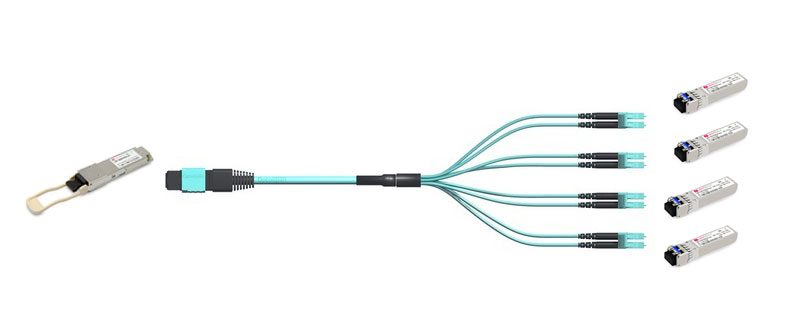

As modern data centers push toward higher east-west throughput and increasingly distributed workloads, many architects are seeking a network evolution path that delivers meaningful gains without the cost and complexity of jumping directly into 100G or 400G. In this context, 25G SR (Short-Reach) transceivers have emerged as one of the most attractive options for upgrading leaf-switch uplinks. Offering a balance of performance, cost efficiency, and operational simplicity, 25G SR provides an accessible stepping stone into scalable spine-leaf architectures.
The Value of 25G in Entry-Level Spine/Leaf Designs
Spine/leaf topology has become the de-facto design standard in cloud, enterprise, and edge data centers due to its predictable latency and horizontal scalability. However, many organizations still rely on legacy 10G uplinks on leaf switches, which creates bandwidth bottlenecks as server-side traffic continues to rise.
25G SR uplinks directly address this limitation, providing:
2.5× more bandwidth than 10G at only a modest incremental cost
Lower power consumption compared to parallel-fiber 40G
Single-lambda optical design, simplifying interoperability and maintenance
Easy migration path, especially when existing fiber cabling is multimode OM3/OM4
For data centers looking to boost leaf capacity without overhauling their entire infrastructure, 25G SR offers a practical upgrade path that aligns with both technical and financial constraints.
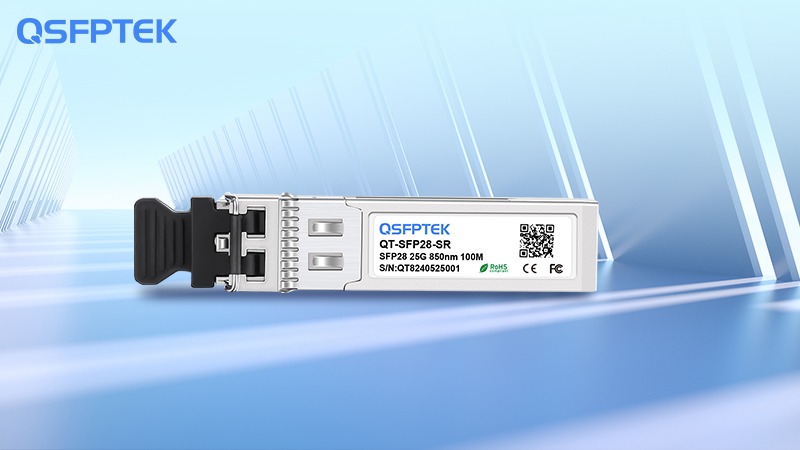
Why 25G SR Is Cost-Effective and Deployment-Friendly
Unlike 40G SR4 or 100G SR4 modules, which rely on MPO/MTP parallel optics, 25G SR uses LC duplex connectors, making it compatible with widespread MMF cabling already deployed in most enterprises. This immediately reduces installation costs, minimizes training requirements, and eliminates the need for new patching ecosystems.
Key benefits include:
Simple Transition From 10G
25G SR transceivers maintain the same optical interface as 10G SR modules, enabling straightforward migration without re-cabling the leaf layer.
Lower Cost per Gigabit
Compared to 40G or 100G solutions, 25G SR provides a significantly better cost-per-bit ratio, an important decision factor for large leaf deployments where port count is high.
Energy Efficiency
Delivering higher data rates without parallel optics reduces both power draw and heat load, helping maintain efficient rack-level thermals.
Performance Advantages in Leaf-Switch Uplinks
When used for leaf-to-spine connectivity, 25G SR delivers predictable and stable performance for east-west traffic patterns, especially in environments focused on virtualization, microservices, and storage mobility.
Optimized for Modern Workloads
VM migration (vMotion)
Distributed storage clusters
Container networking (Kubernetes CNI)
Latency-sensitive service meshes
High-volume API traffic
These applications benefit from low-latency, short-reach optical links, and 25G SR fits perfectly within typical rack-to-aggregation distances (up to 100 m on OM4).
Supporting Progressive Scalability
25G uplinks future-proof the leaf layer. When spine switches are upgraded to 100G or 400G aggregates, leaf switches with 25G SR can scale proportionally without structural redesign.
A Practical Step Toward 100G/400G Infrastructure
While hyperscale operators may be moving toward 100G and 200G server-side connections, many enterprise and mid-size data centers still require a more measured, cost-aligned strategy. 25G SR serves as a bridge technology, enabling:
Incremental bandwidth boosts
Reuse of existing multimode fiber
Smooth evolution toward higher architectural densities
In short, it provides a powerful uplift without the operational overhead associated with more complex optical technologies.
Conclusion
For organizations seeking a cost-effective, high-performance upgrade for their spine-leaf architecture, 25G SR uplinks represent one of the best balance points in today’s data center networking landscape. They deliver substantial bandwidth gains over 10G, integrate seamlessly with existing multimode cabling, and provide predictable low-latency performance suitable for modern workloads.
